Weed Control: Meaning & Sustainable Solutions | Weedingtech

For help or enquiries get in touch at [email protected]

Weed Control Explained: Meaning, Methods & Benefits

A weed, by its simple definition, is a plant growing where it’s not wanted. While all plants, and therefore weeds, play an important role in the ecosystem, there are many settings where they’re not helpful, and need to be removed. 

Put simply, weed control refers to the removal and prevention of unwanted plants to minimise their impact on the surrounding environment.

Why is weed control important?

Weed control is used in different settings for different reasons:

  • Aesthetics - For many public spaces, parks, visitor attractions, weed control is mainly carried out for aesthetic purposes. Weeds can quickly take over, making facilities look messy and neglected. Removing weeds helps to keep spaces looking clean and tidy and makes space for more aesthetic species.
  • Safety - As weeds grow through paving slabs, or moss and algae grow on paths, facilities can become slippery and dangerous, particularly in cold and wet weather. Tackling these weeds helps to reduce slip risks and keep people safe.
  • Agriculture - As plants, weeds need water, light and nutrients to survive. On agricultural land, weeds take up vital space and resources that farmers need for crops. In fact, studies suggest that a 10% weed infestation can equate to a 10% yield loss. Effective weed control is therefore vital to maximise space for crops so farmers can improve yields and profits. 

How is the weed control landscape shifting? 

Methods of commercial weed control have become more sophisticated over time. As technologies have developed, manual weeding has been overtaken by more time-effective machinery and treatments. 

Chemical treatments, namely glyphosate-based herbicides, have become the most commonly-used method of weed control in the past half-century. More recently, however, numerous studies have called the use of glyphosate into question, with evidence linking the chemical to human health risks, particularly cancers.

This has triggered a widespread shift in public opinion, and caused many local authorities to rethink their use of the chemical. In fact, a 2025 freedom of information request by Pesticide Action Network (PAN) UK found that 45% of the local authorities across the UK are taking action to end or reduce their use of pesticide.

Methods of weed control

Manual weeding

The extraction of weeds by hand, or using handheld tools, is safe and simple. It doesn’t damage or disturb the environment, and aside from the cost of gardening tools, is completely free. 

It’s an effective form of eco-friendly weed removal if you’re able to reach and remove the entire root from the ground, but particularly established or deep-rooted weeds can be difficult. Manual plant weeding is also time and labour intensive, and while it can work well for small spaces, it’s not a scalable solution for large commercial areas.

Hot water 

Hot water is a method of thermal weed control and damages weeds by distorting the plant's cells. It’s non-toxic and doesn’t pose any risks to people, animals or the environment.

While hot water kills weeds on the surface, it has no impact on seeds and a very weak effect on the root structure, so it’s not as effective in the long term. It also quickly loses heat to the atmosphere, and is usually not fit for purpose in wet and windy weather.

Steam 

Steam is similar to hot water in many ways, using heat to damage the plant’s cell structure. It’s a form of non-chemical weed control and can be used on all surfaces. 

Steam treatments typically kill the leaves and have some effect on the seeds, but have a very weak impact on root structure, so again, it’s not as effective long-term as other methods. Like hot water, it’s also weather-dependent and loses heat quickly.

Propane weeding 

Propane weeding involves briefly passing an open flame over the weed, rupturing the cells from the intense heat which then causes the plant to die. It’s a herbicide-free weeding treatment that’s usually quick and easy to apply. 

However, propane weeding isn’t as effective at targeting the root as other methods, while the equipment can be heavy and difficult to transport around site. It’s also not suitable in dry or windy weather, as fire can easily catch and spread.

Electricity 

Weeds can also be destroyed using electrical currents, which causes a microwave-like effect, heating up the molecules and causing them to vibrate to destroy the cell walls. This method, sometimes called ‘zapping’ is non-toxic, effective in any weather, and has no adverse effects on people, animals or the wider environment. 

However, the high voltage currents do come with fire and user safety risks, and can sometimes damage surrounding plants. While zapping is an effective form of invasive plant control, particularly for urban areas, the machinery can be expensive.

Strimming 

Strimming, or weed whacking, uses a machine that spins at wire at speed to cut through overgrowth. It’s highly effective to trim back long grass and weeds along borders, helping to keep paths, driveways and roads clear. 

While it cuts the weed on the surface, it doesn’t tackle the root, and the motion disturbs seed beds, causing the spread of seeds and spores. Therefore, strimming alone isn’t an effective form of landscape weed control and must be paired with another method. 

Herbicides

Herbicides are made using the chemical glyphosate, and are usually sprayed onto weeds to disrupt the plant’s vital functions. Herbicides are a fast and effective form of weed control, and are typically quick and easy to apply. 

However, the use of glyphosate is also highly controversial, with scientific research showing the extent of the chemical’s toxicity and raising concerns over its carcinogenic properties. 

The recent Global Glyphosate Study found links between exposure, even at ‘safe’ levels, and incidences of cancer. It’s also known to contaminate waterways and cause damage to wildlife and delicate ecosystems.

Foamstream

Foamstream pairs the power of hot water with biodegradable foam, which acts as an insulating blanket to help maintain the necessary temperatures for long enough to kill or sufficiently damage the weed. The organic foam is made from natural plant oils and sugars making it completely safe for use around people, animals and delicate environments. 

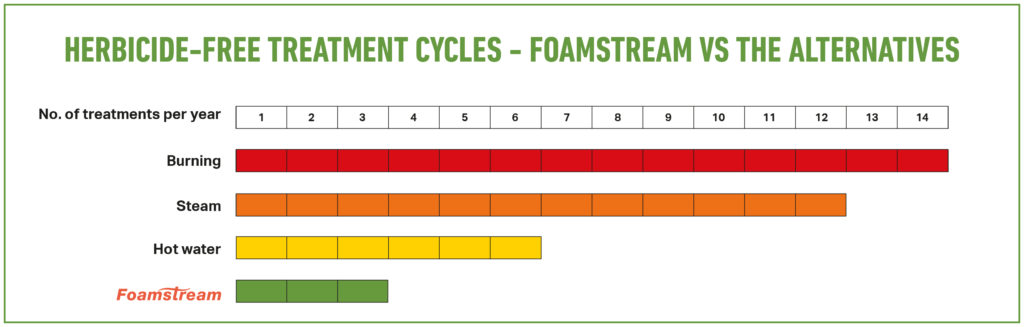
Due to its high kill rate and low number of annual treatment cycles, Foamstream is extremely time and cost-effective in comparison to other treatments. It can tackle weeds with just two to three treatments per year, and eradicates moss and algae with just one.

Image of Foamstream treatment cycles

Foamstream is also a powerful multi-tasker and doubles up as a powerful outdoor cleaning agent that makes light work of grime, gum and graffiti. While users require specialist machinery to dispense the product, it’s a highly efficient herbicide-free weed solution, trusted by councils, private estates, utility companies, visitor attractions, sports facilities and leisure venues across the world.

What’s next for weed control? 

With rising public support for moves to reduce or end pesticide use in public places, the anti-glyphosate movement is only likely to gain traction. And, local authorities are not the only ones taking action. With very real health, safety and environmental concerns surrounding herbicide use, organisations of all sizes and sectors are now seeking viable glyphosate alternatives.

To discuss your requirements and find out how Foamstream can help you, talk to our team today. Or, if you’d like to see it in action on your site, why not book a demo?

To find out more about Foamstream and how it can help your organisation, get in touch today

Get in touch
grey curve grey curve